In Azerbaijan the word "startup" is used for every newly opened café and for technology companies that raise investment alike. People mean different things and make decisions on different grounds. This post explains the concept precisely: what a startup is, how it differs from a small business, its types and stages, and what support exists in Azerbaijan.
At the end we show what marketing should do in the first 90 days. Many startups build the product but postpone checking who will buy it and why.
Short answer: a startup is a young company that solves a new problem and searches for a repeatable, scalable business model that is not yet proven. The key difference: a small business executes a known model, a startup discovers the model.
What is a startup?
A startup is a young company that tests a new product or service idea quickly to find a repeatable, scalable business model. The key word is "search": the model is not yet proven, and the company spends much of its effort learning what the market will pay for.
Well-known thinkers stand behind this idea. Steve Blank describes a startup as a temporary organization searching for a repeatable, scalable model. Paul Graham (Y Combinator) points to fast growth as the defining trait. Eric Ries's Lean Startup organises the search as a build-measure-learn loop.
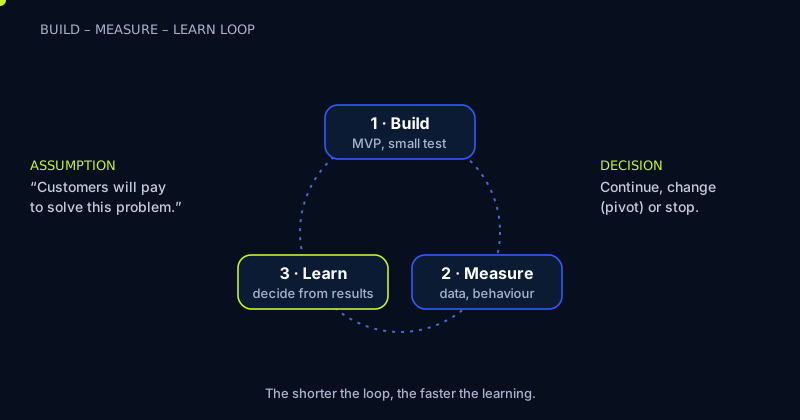
Traits that define a startup:
- A new or different offer: the product, technology or model is not already available on the market.
- Scalability: when revenue grows, cost does not grow at the same pace. Software can be sold to one user or ten thousand with roughly the same product.
- High uncertainty: the price, channel and model are not yet known.
- Repeated testing: assumptions are tested with an MVP and small experiments.
- Need for outside funding: many startups speed up growth with investment, though it is not mandatory.
"Startap" and "startup": is there a difference?
No. "Startup" is the English spelling and "startap" is the phonetic form used in Azerbaijani. People search with both, so we use both.
The official criteria in Azerbaijan
Startup status and related support in Azerbaijan rest on official criteria set by a Cabinet of Ministers decision, and the Small and Medium Business Development Agency (KOBİA) issues the startup certificate. Official terms can change, so check the current requirements at smb.gov.az before applying.
Startup versus a traditional business
The difference is not only the word "technology". It is how each business treats risk, growth and time. The table compares three concepts.
| Criterion | Startup | Small business | Freelancer / sole trader |
|---|---|---|---|
| Goal | Find a new model and scale it | Stable income, strength in a local market | Sell own skills |
| Model | Not yet proven | Tested and familiar | Individual work, hourly or per project |
| Growth | Fast, scalable | Gradual, often local | Limited by the person's time |
| Risk | High, outcomes uncertain | Medium, the market is known | Low to medium |
| Funding | Often investment, grants or bootstrapping | Personal funds, loans | Personal funds |
| First job | Prove the market need | Be visible to the right audience | Find clients |
| Time horizon | Test, then fast growth or stop | Long-term operation | Project to project |
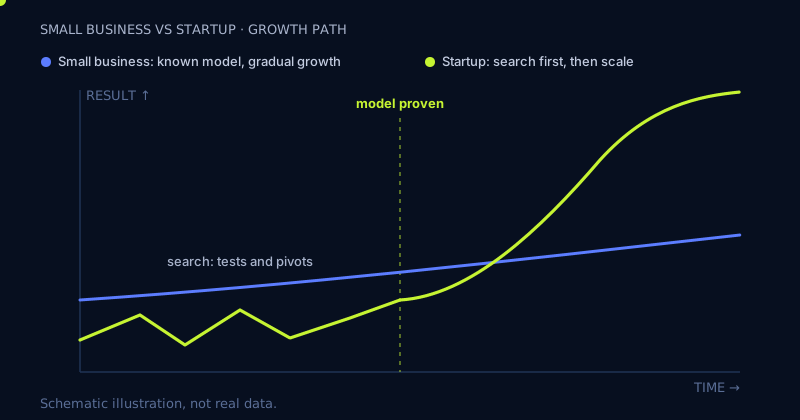
Not every new company is a startup. A new café or repair service is closer to a small business because its model is known. We cover the marketing side of this difference in the marketing guide for a new business.
Types of startups
Startups can be grouped in several ways. These are the most common.
| Type | What it offers | Key test | What to watch in marketing |
|---|---|---|---|
| Technology | Software, platform, app | Reaching many users without a proportional cost rise | Sign-up and activation |
| Social | Solving a social problem | Impact is measured and the model is sustainable | Trust, partnerships, real stories |
| Eco | Environmental solutions | Environmental benefit can be measured | Proof and open data |
| B2B | Selling to companies | Long sales cycle, high value | Expert content, lead quality |
| B2C | Selling to individuals | Many users, small revenue each | CAC and repeat use |
Technology startup
The main value is software, a platform or technology. Typical formats: SaaS, fintech, insurtech, marketplaces and mobile apps. The test: the product can serve many users without a proportional rise in cost.
Social startup
The goal is to solve a social problem alongside earning revenue (access to education, health, disability). The test: impact is measured and the business model sustains it.
Eco and climate startup
Offers new solutions in energy efficiency, waste processing and the environment. The test: the environmental benefit can be measured.
B2B and B2C startups
A B2B startup sells to companies: long sales cycles, few customers, high value per customer. A B2C startup sells to individuals: many users, small revenue each, so acquisition cost and repeat use decide the outcome.
Unicorn
A private startup valued at one billion dollars. It is a rare outcome, not a type, and most startups never reach it. Treat it as an example, not a yardstick.
Startup stages
A startup's path is rarely linear; there are often setbacks and pivots. Still, splitting it into stages shows what matters at each point.
| Stage | Key question | Outcome | Measure |
|---|---|---|---|
| Idea | Is this problem real and important? | A list of assumptions | Interview count, repeated problem |
| Problem-solution fit | Does the target customer need this solution? | A validated problem | Results of customer interviews |
| MVP | Does the simplest version create value? | First working version | First users, usage behaviour |
| Pre-seed and seed | The model works, resources are needed for the next step | First investment, grant or revenue | Growth rate, first revenue |
| Growth | Can the model be repeated at scale? | Steady customer acquisition | Acquisition cost (CAC), lifetime value (LTV) |
| Exit | What happens to the company next? | Sale, merger or IPO | Company value |
Funding amounts per stage vary widely by market and sector, and we do not invent figures here.
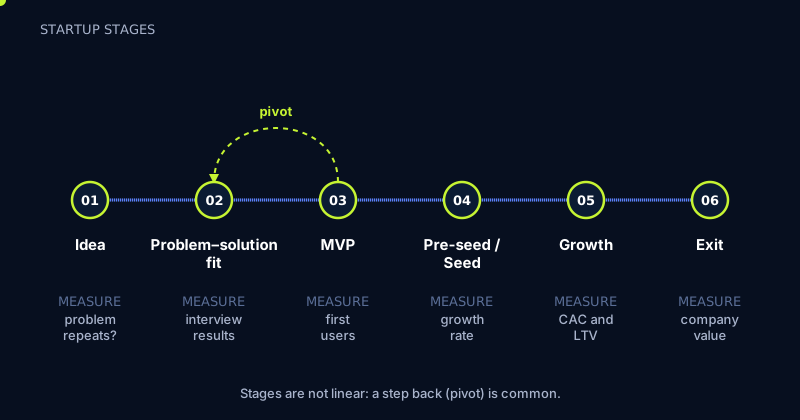
What is an MVP?
An MVP (minimum viable product) is the simplest version that solves the core problem, without every feature. The goal is not an excellent product but testing an assumption at minimum cost. An MVP may not even be software: a landing page, a manually delivered service or a test with a small customer group can qualify.
What are an accelerator and an incubator?
An incubator gives idea-stage or very early teams space, mentoring and initial support. An accelerator speeds up a startup that already has an MVP in a short, intensive programme and often creates access to investors. Both can provide skills and connections but do not guarantee success.
The startup ecosystem in Azerbaijan and the startup certificate
Azerbaijan has several public and private support structures for startups. The following reflects organisations named in public sources. Programme terms and activity can change, so check official websites before reaching out.
The KOBİA startup certificate
KOBİA issues the startup certificate: to be recognised as a startup a company must meet the official criteria and apply. A report.az explainer (in Azerbaijani) covers who can apply and how. Public sources say certificate holders may use a tax benefit on innovative income that applies for a limited period (sources mention 3 years). Because terms, duration and documents can change, read the current rules at smb.gov.az before deciding and confirm with an accountant or lawyer if needed.
Support structures and programmes
- Innovation and Digital Development Agency (IDDA): the state body for innovation and digital development, involved in startup ecosystem initiatives (news source, in Azerbaijani).
- ASAN-related programmes: for example "Azerbaijan 500 ASAN Startup" and Innoland, which collects startup ideas, incubates them and helps build prototypes.
- AzInTelecom "Azcloud ScaleUp": a programme oriented to cloud services and growth support for startups. The announcement dates from 2021, so check its current status.
- Caucasus Ventures: presented as Azerbaijan's first venture capital fund, investing in early-stage technology startups (with PASHA Holding participation). See the ministry's project page.
- "Yeni Fikir" competition: a contest where young teams present startup ideas (Wikipedia). The latest edition we could confirm is from 2019, so check whether it is currently active.
Strategy documents such as the Digital Economy Development Strategy for 2026–2029 (in Azerbaijani) also target the digital economy and the startup ecosystem. For local startup news and initiatives, see the startup.az portal.
Pick the closest-fit programme first, then apply. The same application sent to every programme rarely gives a strong result in any of them.
Why do startups fail?
Most of the failure-rate figures in circulation are unsourced and we do not repeat them. The causes, however, are consistent: most startups fall because the market need was not tested before product quality.
- No market need: the team builds a product but never finds a real problem to solve for anyone.
- Running out of cash: growth costs outpace revenue and the next funding does not arrive in time.
- Team problems: mismatched skills, decision-making and responsibility.
- Weak unit economics: acquiring a customer costs more than the customer brings in.
- Bad timing: entering the market too early or too late.
- Late marketing: talking to the first customers is postponed until the product is ready.
Most of these causes can be found earlier, in the testing phase. We show a small test plan in the new business marketing post.
How to build a startup: 7 steps
The sequence below is a general frame. The order may change by sector, but do not skip the first two steps.
- Define the problem. Who struggles, in what situation, and why? If you cannot write it in one sentence, you are not ready.
- Talk to customers. 10-20 short interviews with potential customers: how do they solve the problem now, and how much time and money does it cost them?
- Build the simplest MVP. A landing page, a manually delivered service or a short prototype. Do not wait for a perfect product.
- Choose the legal form. Discuss the company form and tax regime with an accountant or lawyer. Keep the startup certificate's requirements in mind at this stage.
- Check the startup certificate and support programmes. Verify eligibility for KOBİA, IDDA and other programmes on official sites.
- Find the first customer. Test the price, message and channel with a small budget. The first paying customer is the strongest validation.
- Set up measurement. Track user behaviour, conversion and acquisition cost from day one so decisions rest on data, not guesses.
Startup marketing: the first 90 days
A startup's first marketing job is learning, not a sales record: who buys, why, which message works, and which channel brings cheap, good-quality customers. The first 90 days should answer these questions.
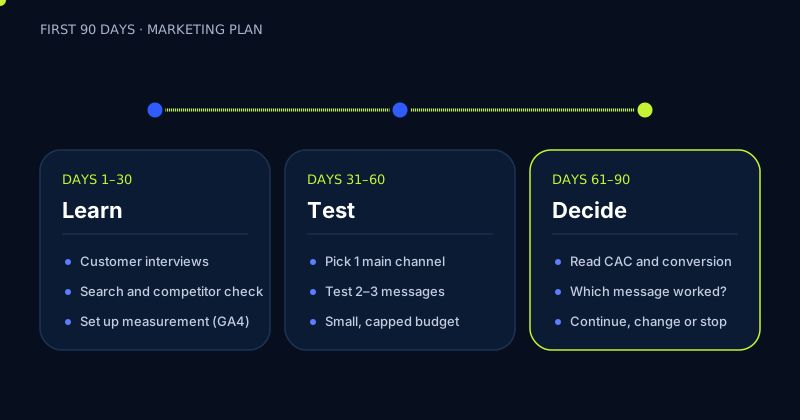
Check demand
Verify search volume, competitor ads and query trends with small data sources. We wrote the methods step by step in the marketing guide for a new business.
Choose the first channel
How does the customer look for you? Google Ads and SEO suit customers with search intent, Meta Ads suit visually driven buyers, and expert content and LinkedIn can fit B2B. See the digital marketing guide for a comparison of channels.
| Startup type | How customers look | First channel | First metric |
|---|---|---|---|
| B2C mobile app | Sees it in the store and on social media | Meta Ads, Apple Ads and Google app campaigns | Installs and activation |
| Search-intent service or SaaS | Searches for the problem on Google | Google Ads and SEO | Number of enquiries or demos |
| B2B solution | Researches, asks for recommendations | Expert content, LinkedIn, SEO | Qualified leads |
| Marketplace | Needs two sides: buyers and sellers | Attract one side first, then the other | Activity on both sides |
Set up measurement
Define the main conversion events in GA4 (form, sign-up, first payment). We explain which metrics to watch in the marketing KPI and GA4 post.
Understand unit economics
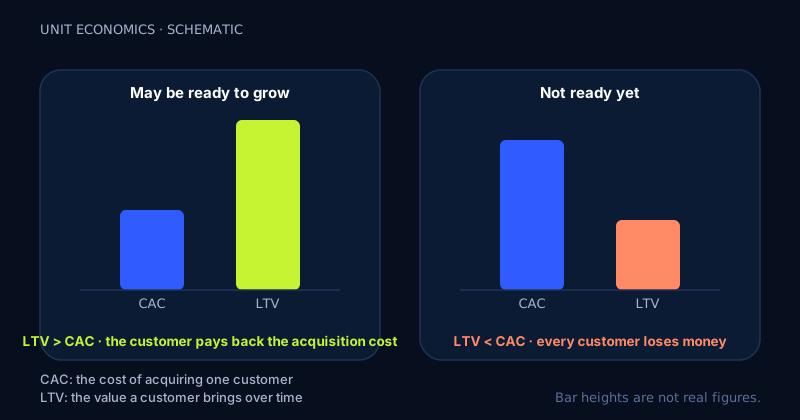
The ratio between the cost of acquiring a customer (CAC) and the value the customer brings over time (LTV) shows whether the startup is ready to grow. If precise data is not available yet, try to measure the ratio as a test result, not an estimate.
Be visible in AI search
Many users already put their question to ChatGPT, Gemini and Google's AI overview. Clear definition blocks, FAQs and reliable sources raise your chance of appearing in those answers. More in our AEO and GEO post.
If terms confuse you, our marketing glossary can help. For a content channel see the content marketing strategy post.
Startup consulting: where I can help
I, Azar Ismayilov, who wrote this post, have worked in digital marketing for 10+ years. As a manager at Insure.az I grew the platform's active users from 30,000 to 170,000+. That growth came not from ads alone but from improving the product funnel and B2B partnerships. I am currently also working on product ownership for an e-commerce marketplace and mobile app. I am also a certified consultant of the EBRD and Civitta programme "Advising Innovation: Consultant Training for Startup Support in Azerbaijan" and have taken part in mentorship programmes.
Based on this experience I can consult startups in these areas:
- Validating demand and the MVP: a list of assumptions, customer interviews, the first test.
- Go-to-market plan: choosing the first channel, message tests, small-budget ad tests.
- Measurement and unit economics: GA4 and conversion tracking, a CAC and LTV frame.
- Presentation materials: a simple, data-led pitch deck structure for partners and investors.
- Product and growth priorities: backlog, feature prioritisation, attribution for mobile apps.
Consulting does not guarantee results. The aim is to help you make decisions based on tests and data, not guesses.
Frequently asked questions
What is a startup?
A startup is a young company that solves a new problem and searches for a repeatable, scalable business model. Its main difference from a small business is that the model is not yet proven and uncertainty is high: the company spends a large share of its effort learning.
What is the difference between a startup and a small business?
A small business executes a tested model, usually in a local market, and aims for steady income. A startup searches for a new, scalable model, carries more risk and often uses outside funding. In marketing terms its first job is to prove the market need, not to sell.
Are "startap" and "startup" the same?
Yes. "Startup" is the English spelling and "startap" is the phonetic form in Azerbaijani. The word means a company at an early stage searching for a new model.
What types of startups are there?
The most common types are technology (SaaS, fintech, marketplace, mobile app), social, eco, B2B and B2C startups. A unicorn (a company valued at one billion dollars) is a rare outcome, not a type.
What are the stages of a startup?
A general split: idea, problem-solution fit, MVP, pre-seed and seed funding, growth and exit. The key question differs at each stage: first whether the problem is real, later whether the model can be repeated.
What is an MVP?
An MVP is a minimum viable product: the simplest version that solves the core problem. The aim is not an excellent product but testing an assumption at minimum cost. It can be a landing page, a manually delivered service or a small prototype.
Who can get a startup certificate in Azerbaijan?
KOBİA issues the certificate, and the applying company must meet the official startup criteria. Exact requirements and documents can change, so check the current rules at smb.gov.az before applying.
What tax benefit does a startup certificate give?
Public sources say certificate holders may use a limited-period tax benefit on innovative income. The scope, duration and conditions can change, so confirm with the official source and an accountant or lawyer before deciding.
How do you build a startup and where do you begin?
Begin by defining the problem and running 10-20 short interviews with potential customers. Then build the simplest MVP, check the legal form and support programmes, find the first customer and set up measurement from day one.
How should a startup plan its marketing budget?
There is no fixed percentage. First learn the cost of one lead or one sale in a single channel with a limited test budget, then grow the budget using that data. In the first 90 days the aim is not to spend a large budget but to find which message and channel work.
Conclusion
A startup is not every newly opened company. It is a company that quickly tests a model that is not yet proven. So a startup's first job is not to build a perfect product but to prove the market truly needs it.
If you want a marketing plan for your idea, your MVP or your first customer test, we can begin with an audit and consultation.
Shall we build a first 90-day marketing plan for your startup's stage together?
Audit and consultation for startups