One of the questions I hear most often from online store owners lately is: "Do our products show up in ChatGPT, and how do we get them there?" Semrush recently published a detailed guide on exactly this topic: How to optimize for ChatGPT shopping (Zach Paruch, 4 November 2026). I think it is a good reference for anyone interested in the subject. I have summarised the key ideas and added notes from our own practice and examples from the Azerbaijani market.
Shoppers used to make their choices on Google, on marketplaces or in forums. Now many ask ChatGPT directly: "Which air conditioner should I buy for an apartment in Baku?", "What is the difference between these two vacuum cleaners?". The answer shows product cards with images, prices and review summaries. According to Semrush, more than 1 billion people use ChatGPT every week.
The question is simple: are your products in those cards? Below I explain what it takes to get products shown in ChatGPT, what a store in Azerbaijan can do today, and what is still to come. For context: in March 2026 OpenAI stepped back from in-chat payments (Instant Checkout). The focus is now on product discovery, and the purchase happens on the store's own site.
Short answer: to appear in ChatGPT shopping, OpenAI's search bot (OAI-SearchBot) must be able to read your site, price, stock and specs must be in the HTML and in Product schema, you need a strong Google Shopping presence, product descriptions must answer shoppers' real questions, and your brand needs to appear on review sites. A merchant feed adds control but is optional.
What is ChatGPT shopping?
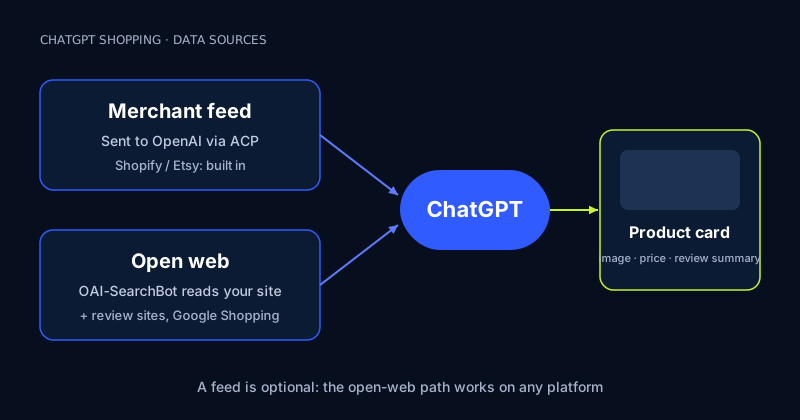
ChatGPT shopping is the feature that shows product cards with images, prices and review summaries when a user asks a shopping question. The data comes from merchant feeds or the open web. These results are not ads, and you cannot pay to appear in them. Cards sometimes include labels like "Budget-friendly" and a short summary of what reviewers like and dislike.
The feature is less than a year old but has already changed significantly:
- 2025: OpenAI launched the feature. ChatGPT gathers products from across the web and recommends them based on structured data such as prices and reviews.
- September 2025: Instant Checkout arrived. Through the Agentic Commerce Protocol (ACP), shoppers could pay without leaving ChatGPT.
- March 2026: OpenAI stepped back from Instant Checkout, citing a lack of flexibility. ACP was expanded instead: stores now use it to share product and promotion data.
Three things to know:
- The feature is currently fully live only in the US, with expansion to other regions planned.
- ChatGPT also has ads, but OpenAI labels them and keeps them separate from recommendations. We shared our own ChatGPT ads test in a separate post.
- Products reach ChatGPT in two ways: a merchant feed (built in for Shopify and Etsy) and the open web (ChatGPT pulls data from your site and third-party sources).
What does this mean for a store in Azerbaijan?
The feature is officially US-only, so it is easy to say "this doesn't apply to us yet". In our view that is the wrong conclusion, for three reasons.
The preparation is the same. Crawler access, server-side rendering, schema and quality product data are needed for Google Shopping, Gemini, Perplexity and for ChatGPT shopping when it reaches the region. This is the common foundation of AI search visibility, which we cover in detail in our AEO and GEO post.
Shoppers are already asking. Even without product cards, people ask ChatGPT "where can I find this model in Baku" or "which is better value", and ChatGPT answers with web search. Your site can be cited as a source in that answer, and so can your competitor's.
For brands selling abroad, this is a today issue. For Azerbaijani brands selling to the US via Shopify, Etsy or their own site, ChatGPT shopping is already a working channel.
In our observation, dedicated preparation for AI crawlers is still rare among local stores. Competition is low, and early movers gain an advantage.
Can ChatGPT read your site?
If OpenAI's bot cannot open and read your product page, ChatGPT cannot recommend the product. For stores without a feed, the website is the main source, so this part applies to everyone.
Prices must be in the HTML
According to Vercel's 2024 research (The rise of the AI crawler), OpenAI's crawlers do not execute JavaScript. In a 2026 Semrush test, when a user shared a page link with ChatGPT, the model summarised only the page's raw HTML. The takeaway: price, stock and key specs must be in the HTML the server sends, not loaded later by JavaScript.
This is the first thing we check in store audits: we press Ctrl+U on a product page and search for the price. If it is not in the page source, the crawler does not see it either. The test takes a minute but reveals most technical problems right away. It is common on stores built with React or Vue and is solved with SSR or SSG in Next.js or Nuxt.
robots.txt: which bots to allow?
OpenAI has several bots, and they should not be confused (OpenAI bots documentation):
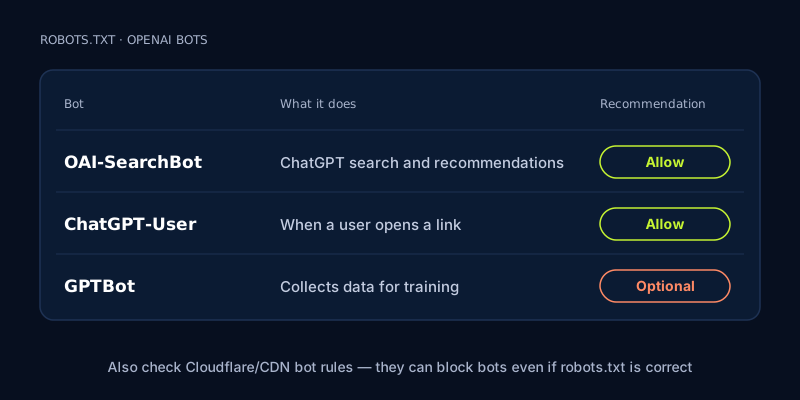
User-agent: OAI-SearchBot
Allow: /

User-agent: ChatGPT-User
Allow: /

User-agent: GPTBot
Disallow: /
CDN and firewall
CDNs like Cloudflare let you block AI bots with one click, and since mid-2025 Cloudflare blocks AI crawlers by default on new domains. If someone switched this on "for security", OAI-SearchBot cannot reach the site even when robots.txt is correct.
In technical audits we always check the CDN bot settings alongside robots.txt, because the two are often managed by different people: one by the SEO specialist, the other by a developer or the hosting team.
Product schema
ChatGPT uses structured data from first- and third-party sources when recommending products. At minimum, include the properties Google requires: name, image and offers (price, priceCurrency; availability is recommended). The requirements are in Google's Product documentation. Beyond the minimum, add:
- review and aggregateRating, only if real reviews are visible on the page;
- material, color, description;
- itemCondition;
- shippingDetails and hasMerchantReturnPolicy, inside offers or at Organization level;
- gtin (or gtin13), mpn, brand.
If a product has several variants (colour, size), use ProductGroup alongside Product (Google: product variants). It tells Google which pages are separate products and which are variants, and you don't need to repeat shared data on every variant.
If prices are in manat, set priceCurrency to "AZN". The price in schema must match the page: mismatches or invented ratings violate the guidelines.
If any item in this section is broken, your visibility suffers across AI search, not just in ChatGPT shopping. For a general technical check, see our technical SEO checklist.
How does ChatGPT choose which products to recommend?
OpenAI does not disclose the exact algorithm. But observations and official guidance point to several strong signals: Google Shopping position, page readability, descriptions that answer shoppers' questions, and off-site reviews.
Overlap with Google Shopping
- In a Semrush experiment, the top product ChatGPT recommended appeared in Google Shopping's top three results 75% of the time.
- A March 2026 Peec AI study found that about 83% of products in ChatGPT cards also appeared among Google's top 40 organic products. Paid ads were excluded.
So work in Merchant Center pays off in ChatGPT too. Google's main recommendations:
- check that free listings are on;
- write clear titles that match the product page;
- add GTIN and MPN;
- upload images from several angles and in use;
- fix errors in Merchant Center Diagnostics regularly;
- collect reviews, since star ratings can appear in free listings;
- update the feed and the site at the same time.
The details of feed and Shopping setup are in our e-commerce SEO guide.
Product pages and content: how to write for AI
Page structure
On-page SEO rules still apply (title and H1 rules):
- The H1 should carry the main product name; H2s should separate sections like "About the product", "Specifications" and "Customer reviews".
- Price and stock should be visible as text, not inside images.
- Put specifications in an HTML table, not an image or PDF.
- Don't offer reviews only as video: shoppers like it, but ChatGPT doesn't "see" it. Add a written review section below.
Query fan-out: answer the questions shoppers didn't ask
Query fan-out is how ChatGPT splits one question into several sub-queries and combines the results. The model adds criteria the user never mentioned.
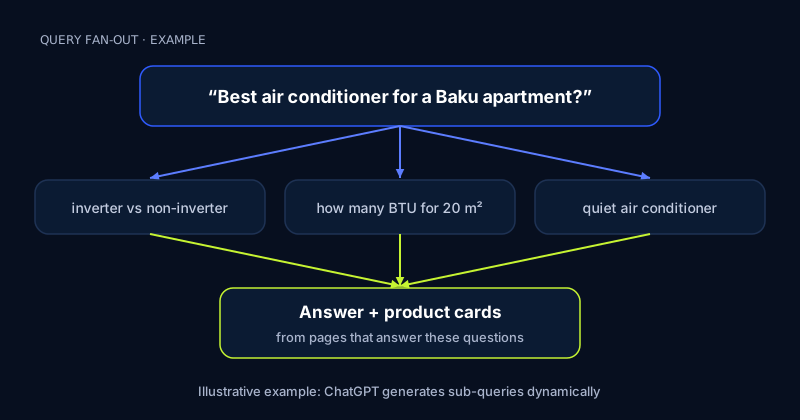
If your product page answers these sub-queries, ChatGPT is more likely to pick it. OpenAI asks for factual, plain descriptions in the feed. On your site, write rich, conversational descriptions:
- Weak: "A modern air conditioner that brings coolness to your home."
- Strong: "Inverter compressor, 9000 BTU for 20–25 m² rooms, 22 dB in night mode, A++ energy class."
Then answer the questions shoppers ask ChatGPT:
- Use case: is it quiet enough for a bedroom? Does it work at 40°C in a Baku summer?
- Budget: what do you get at this price, and how does it differ from a cheaper model?
- Comparison: how does it differ from the models shoppers compare it with?
Generic lines like "an elegant design that suits any home" give ChatGPT nothing useful to pass on. If you write thousands of descriptions with AI, apply our AI content quality control rules.
Thousands of products: use templates, not manual work
In a store with 2,000 SKUs, fixing every page by hand is not realistic. The work happens in the product template: get the template right and the whole catalogue improves at once.
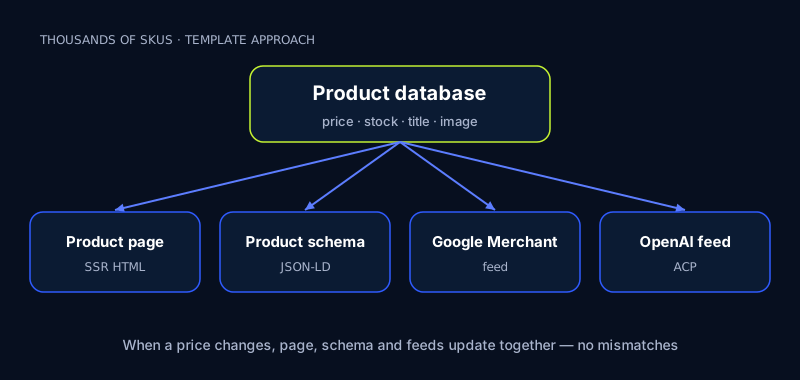
- Generate schema from the template. Build Product JSON-LD automatically from the product database. For variants use ProductGroup, productGroupID, variesBy and hasVariant. Don't output empty fields: if there is no GTIN, omit the property.
- Feed pages and feeds from one source. The product database is the single source for price, stock, title and image. When a price changes, the page cache and the feeds update together.
- Create attribute pages only where there is demand. Fan-out sub-queries often take a "category × attribute" form: "9000 BTU inverter air conditioner", "aluminium frame kids' bike". Open such a page only when there is real search demand (or Search Console impressions), at least 3–5 matching products and text specific to that combination. Point other filter combinations to the main category with a canonical.
- Watch for thin pages. Pages where only the attribute name changes, with 1–2 products, perform poorly in both Google and AI search. Start with 10–20 pages, watch indexing in Search Console for 4–8 weeks, then expand.
Off-site trust: what does ChatGPT read about you?
ChatGPT searches the web to answer, so your off-site presence matters as much as on-site optimisation.
When a user writes "compare this model with a competitor's equivalent", ChatGPT looks at review sites covering those products alongside product pages, and cites them. If your brand isn't on those pages, or the information is outdated, the answer is weak and the shopper may switch to a competitor.
- Encourage customers to leave detailed reviews on Google, marketplaces and review platforms. Never fake reviews: it is risky for both compliance and trust.
- Offer product samples to local tech and lifestyle publications for their comparison articles.
- Reach out to publications, YouTube and Telegram reviewers who haven't covered you yet or cover you with outdated information.
- Check which sources ChatGPT cites for your category. Getting featured there is the most direct route.
Who needs a merchant feed, and how is it submitted?
This step is optional but gives more control over how products appear in ChatGPT. For now it mainly applies to brands selling to the US. For local stores it is still useful to know the process in advance.
Application and submission
You fill in an application on OpenAI's website: company details, main product categories, feed size (number of SKUs) and confirmation that the feed meets the specification. You then join the onboarding waitlist.
Once approved, the feed is shared via ACP. No custom integration is needed: feeds are accepted over SFTP, through providers like Salesforce and Stripe, by file upload or via API. The recommendation: send the full feed once a day as a file, and intraday price and stock changes via API. Promotions are accepted only via API.
The 9 required fields
| Field | Example |
|---|---|
| item_id | AC-INV-9000-WH |
| title | Inverter air conditioner 9000 BTU, white, A++ |
| description | Inverter air conditioner for 20–25 m² rooms, 22 dB in night mode. |
| url | https://example.az/product/inverter-air-conditioner-9000-btu |
| brand | Brand name (as written on the page) |
| seller_name | Store name |
| image_url | https://example.az/images/air-conditioner-9000.jpg |
| availability | in_stock, out_of_stock, pre_order, backorder or unknown |
| price | 1149.00 AZN |
Field names follow the specification as given in Semrush's November 2026 guide. Check against OpenAI's current documentation before submitting.
- Titles up to 150 characters, descriptions up to 5,000.
- The feed must match the page: brand name as on the page, and the URL should open the specific variant where possible.
- Optional fields: condition, material, dimensions, age_group, additional_image_urls, review_count, star_rating, accepts_returns, return_policy.
OpenAI hasn't confirmed that optional fields directly increase visibility. But the logic is simple: your product can only be recommended to someone searching for "rubber toddler shoes" if material and age group are in the feed.
Important: if you already have a Google Merchant Center feed, you may not need a new one. OpenAI accepts Google-compatible feeds if it confirms this during onboarding.
How do you measure results?
A fixed prompt set
Pick 20–50 shopping prompts for your category ("office chair under 300 manat", "X vs Y comparison") and check them in ChatGPT regularly. You can automate this with tools like the Semrush AI Visibility Toolkit or Peec AI, or track it manually in a spreadsheet. For clients we keep the prompt set in a spreadsheet and re-check the same prompts every month. What matters is the trend, not a single result.
AI traffic in GA4
- ChatGPT traffic often arrives with utm_source=chatgpt.com or an HTTP referrer.
- According to Semrush, GA4's "AI assistant" default channel group automatically separates visits from AI sources. If your property doesn't have it, create your own channel group with sources chatgpt.com, perplexity, gemini.google and copilot.
- Depending on the browser, the referrer can be stripped and the visit recorded as "direct". So also watch for unusual growth in direct traffic to product pages.
For KPI setup see our GA4 KPI guide, and for judging AI traffic's impact on sales see data-driven vs last click.
Ask the customer
After purchase, ask a short question: "How did you find us?" Include ChatGPT among the options. It's simple, but it shows what analytics can't.
What will change next?
- expansion beyond the US;
- the Universal Commerce Protocol, an agentic commerce standard co-developed by Google;
- the self-serve merchant platform OpenAI plans for 2026.
Feed specs, portals and checkout options will change. What stays the same: crawler access, accurate product data that matches your site, and trust signals from other sites. Check OpenAI's commerce documentation regularly, keep feeds in sync with your site, and track key prompts so you notice a drop in visibility right away.
Is your store ready for ChatGPT shopping? An 11-point checklist
- robots.txt does not block OAI-SearchBot or ChatGPT-User.
- CDN and firewall do not block AI bots.
- Price, stock and specs appear in the page source (HTML).
- Product schema includes name, image and offers, and matches the page.
- ProductGroup is used for products with variants.
- Specs are in an HTML table; reviews are in text form.
- The Google Merchant Center feed is error-free and free listings are on.
- Descriptions of best sellers answer shoppers' real questions.
- Schema and feeds are generated from the product database, and price mismatches are checked.
- The brand appears with current information on key review and comparison sites.
- AI traffic is tracked separately in GA4, and the prompt set is checked monthly.
Main source: Semrush, How to optimize for ChatGPT shopping, Zach Paruch, 4 November 2026. Adapted for the Azerbaijani market and extended with practical notes.
Frequently asked questions
Does ChatGPT shopping work in Azerbaijan?
The feature is currently fully live only in the US, with expansion planned. But when ChatGPT answers product questions with web search, it can cite Azerbaijani sites too, so it makes sense to do the technical preparation now.
Do I have to pay to appear in ChatGPT shopping?
No. According to OpenAI, shopping results are not ads. Ads in ChatGPT are labelled and shown separately from recommendations.
If I block GPTBot, will I disappear from ChatGPT?
No. GPTBot collects content for model training. Search and recommendations use OAI-SearchBot, so keep that one allowed.
Do I need Shopify for ChatGPT shopping?
No. The open-web path works on any platform: WordPress, Next.js or a custom build. Shopify and Etsy only come with the feed integration built in.
Does a Google Merchant Center feed work for ChatGPT?
OpenAI accepts Google-compatible feeds if it confirms this during onboarding. In addition, a strong Google Shopping position often overlaps with ChatGPT recommendations.
How can I see ChatGPT traffic in GA4?
Look at the AI assistant channel group, the utm_source=chatgpt.com source and the referrer. Since referrers can be stripped, also watch for growth in direct traffic to product pages.
Why was Instant Checkout discontinued?
OpenAI's announcement cited a lack of flexibility and said it would focus on improving product discovery. Purchases now happen in the store's own checkout.
Conclusion
ChatGPT shopping is still taking shape and hasn't fully reached Azerbaijan. But the work it requires already helps sales today: a readable site, accurate product data, a strong Google Shopping presence and off-site trust. A store that prepares early won't be starting from zero when the feature arrives.
Start small: check your robots.txt and CDN settings, fix the pages and schema of your 20 best sellers, and set up a 20-prompt tracking sheet.
Shall we check how ready your store is for AI search?
AEO/GEO service